TL;DR
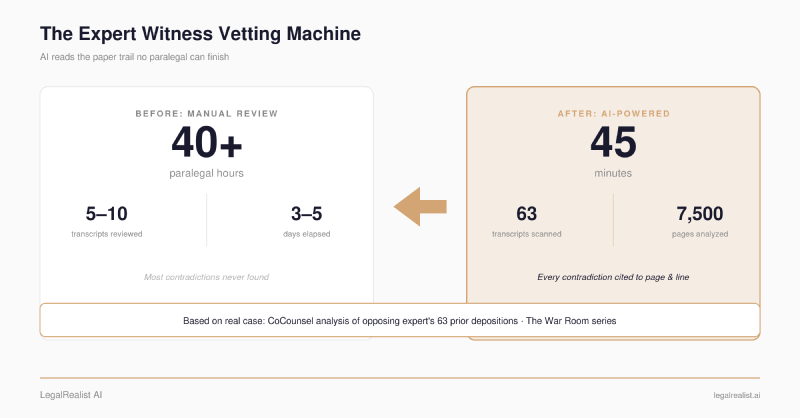
- The data already exists; nobody reads it. PACER, TrialSmith’s 769,000+ deposition transcripts, PubMed, and Expert Institute’s Radar profiles contain everything needed to vet an expert. A California firm used CoCounsel to analyze 63 prior transcripts – 7,500 pages – of a single opposing expert in 45 minutes.
- Vetting output is cross-examination material, not an exclusion motion. Most of what contradiction mining surfaces goes to credibility. Turning any of it into a reliability challenge is separate attorney work.
- Experts are using AI too – and it’s a new attack vector. 20% of experts now use AI in court-related work. Courts are excluding testimony over hallucinated citations, and Kohls v. Ellison points toward a Rule 11 duty to ask whether an expert used AI. The deposition questions, Daubert challenges, and discovery requests this opens are procedural ground most litigators haven’t mapped yet.
- Run the analysis on your own expert first. The same AI tools that find contradictions in opposing experts can reveal vulnerabilities in yours before opposing counsel finds them on cross.
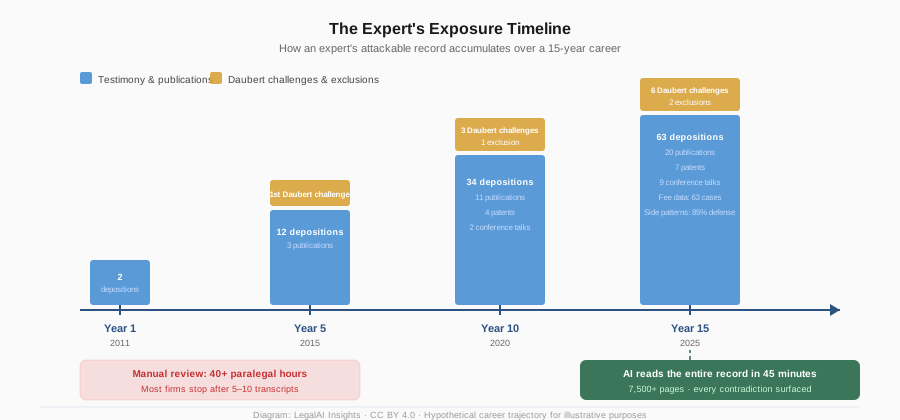
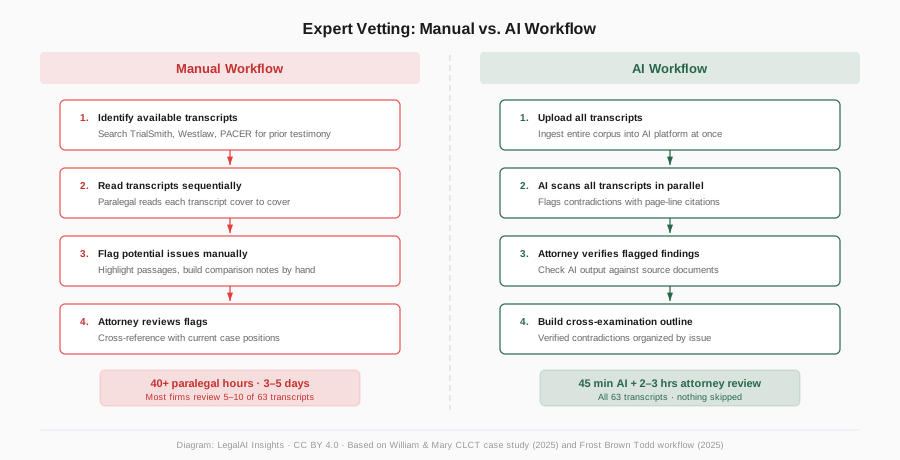
A California plaintiff’s firm uploaded 63 prior deposition transcripts of an opposing expert witness into CoCounsel. The transcripts totaled over 7,500 pages. The AI reviewed them in 45 minutes, flagging statements inconsistent with the expert’s current report and providing citations to the specific prior testimony. A task that would have consumed days of paralegal time – reading every page, cross-referencing positions across cases, mapping contradictions to the current matter – was finished before lunch.
That firm wasn’t doing anything new in principle. Lawyers have always tried to impeach experts with their own prior testimony. What changed is the scale. No paralegal reads 7,500 pages looking for a single inconsistency on a medical imaging methodology. The AI does – and unlike the paralegal, it doesn’t skim.
The Paper Trail#
Nobody reads most of it. The volume is prohibitive, the sources are scattered across different systems, and the economics of manual review rarely justify the hours. But the raw materials are there.
Deposition and trial transcripts from prior cases are available through databases like TrialSmith (769,000+ transcripts contributed by plaintiff firms across 76 trial lawyer associations), IDEX, LexisNexis, and Westlaw. Academic publications are indexed on PubMed, SSRN, and Google Scholar. Federal court filings live on PACER. Patent filings are searchable through the USPTO and Google Patents. Conference presentations, regulatory comments, and media appearances leave traces across the open web. Professional licensing and disciplinary records are maintained by state boards. And platforms like Expert Institute’s Expert Radar and Expert Witness Profiler aggregate litigation history, Daubert challenge outcomes, and party-side patterns into searchable profiles.
The constraint was always human reading time. An LLM removes it.
What AI Actually Does With Expert Testimony#
Contradiction Mining Across Cases#
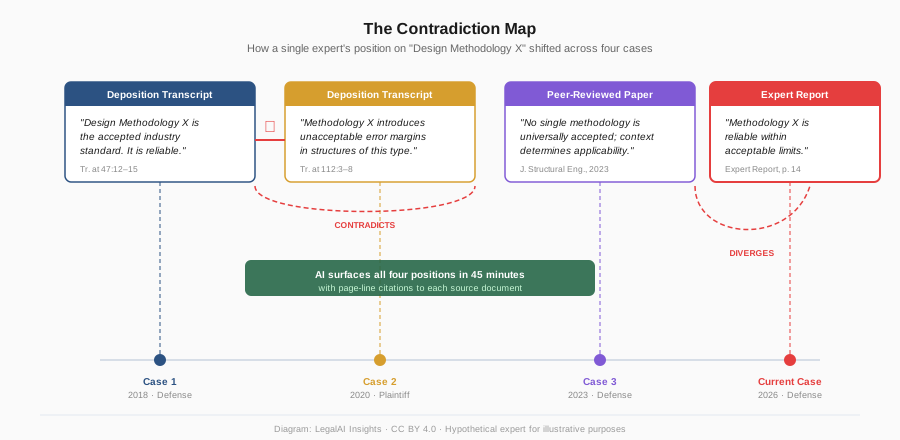
An expert testifies in Case A that “standard industry practice requires X.” In Case B, the same expert testified that “Y is the accepted standard.” An LLM ingesting both transcripts flags the contradiction and cites the specific passages. One product liability defense team used CoCounsel to review over 200 expert witness deposition and trial transcripts for a manufacturing client, building a searchable database of inconsistencies across experts who frequently appeared as adverse witnesses.
The 63-transcript case study showed the AI identifying not only inconsistencies in the expert’s positions but also contradictions in commentary on a specific medical imaging study across prior cases. The AI also formulated alternative conclusions the expert may have rejected or failed to consider – generating lines of cross-examination the attorney hadn’t anticipated.
Publication-to-Testimony Divergence#
An expert’s academic publications may reach different conclusions than their litigation testimony. This is classic impeachment material under FRE 613 (prior inconsistent statements), but finding it requires reading across two fundamentally different document types – journal articles and deposition transcripts – written in different registers for different audiences. An LLM trained on both academic and legal text handles this naturally. If an engineering expert published a peer-reviewed paper concluding that a particular design methodology introduces measurable error rates, but testifies in litigation that the same methodology is reliable within acceptable margins, the AI surfaces both documents and the discrepancy.
Daubert Exclusion History#
Has this expert been excluded under Daubert before? Under what standard? In which courts? On what grounds – methodology, qualifications, application to facts? This is structured data trapped in unstructured judicial opinions, scattered across PACER and state court filing systems. LLMs are well-suited to extracting it. Dedicated platforms now track Daubert and Frye challenge history with real-time alerts, and transcript databases include over 128,000 Daubert, Kumho, and Frye motions.
Fee and Engagement Pattern Analysis#
How often does this expert testify? Always for the same side? Always retained by the same firms? What are they charging? The 63-transcript case specifically included prompts to identify the expert’s fee claims across prior depositions. Bias indicators that are technically available but practically invisible without aggregation become obvious when an AI reads every transcript and compiles the pattern.
Scientific Claim Verification#
A research model is designed to verify whether evidence in scientific studies actually supports the conclusions drawn from it. If an expert’s report cites Study Z to support Claim Y, the model can evaluate whether Study Z actually supports that claim. Still under development, but it points toward AI that doesn’t just find contradictions in what an expert said – it evaluates whether the science the expert cites actually supports the opinions they’re offering.
What Daubert Actually Reaches#
The Daubert standard, established in Daubert v. Merrell Dow Pharmaceuticals, Inc., 509 U.S. 579 (1993), requires trial judges to act as gatekeepers for expert testimony under Federal Rule of Evidence 702. Kumho Tire Co. v. Carmichael, 526 U.S. 137 (1999), extended the inquiry to all expert witnesses. General Electric Co. v. Joiner, 522 U.S. 136 (1997), reinforced that courts can exclude opinions when there is too great an analytical gap between the data and the conclusion.
The Daubert considerations are flexible and non-exhaustive, and courts apply them to the expert’s methodology rather than to their consistency as a witness. That distinction governs what vetting is good for. A contradiction between two prior engagements is impeachment material: it goes to credibility, and credibility is for the jury. It becomes a reliability question only where the record shows the expert applying different methods to materially similar facts without explanation – and even then the argument has to be built, not inferred from the contradiction.
A motion to exclude requires the challenging attorney to identify what is unreliable about the method and support it with evidence. Vetting supplies raw material; the motion, the argument, and the judgment about whether an inconsistency is impeachment or a methodological defect remain attorney work.
Attacking the Expert’s AI Use#
A 2025 survey of expert witnesses found that 20% used AI tools in court-related work – double the prior year. Courts are already drawing lines.
The Cases Drawing the Line#
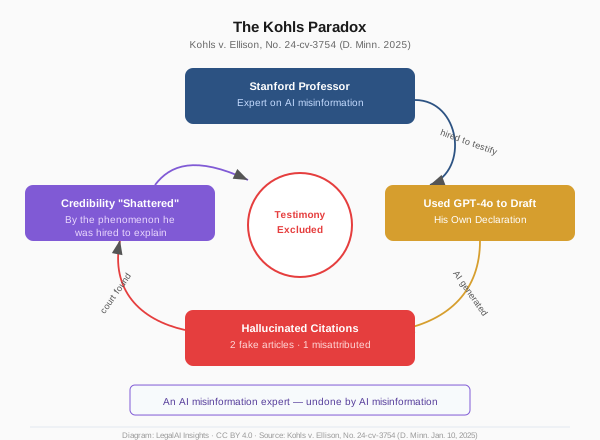
In Kohls v. Ellison, No. 24-cv-3754 (D. Minn. Jan. 10, 2025), Stanford Professor Jeff Hancock – hired to testify about the dangers of AI-generated deepfakes – submitted a declaration drafted with help from GPT-4o that contained citations to two nonexistent academic articles and misattributed a third. Judge Laura Provinzino excluded the declaration, noting that the citation errors “shatters his credibility,” and suggested that Rule 11 may now require attorneys to ask witnesses whether they used AI and what verification steps they took. A Stanford expert on AI misinformation, undone by AI misinformation.
Kohls wasn’t isolated. In Concord Music Group, Inc. v. Anthropic PBC (N.D. Cal. May 2025), a data scientist employed by Anthropic submitted a declaration containing a citation with fabricated authors. Magistrate Judge Susan van Keulen struck the affected paragraph, noting that the error undermined the declaration’s overall credibility. In Matter of Weber (N.Y. Sur. Ct.), the court found an expert’s testimony non-credible in part because he could not recall what prompt he used to generate his AI-drafted report. And in Ferlito v. Harbor Freight Tools USA, Inc., No. CV 20-5615 (E.D.N.Y. Apr. 23, 2025), a court allowed expert testimony involving AI – because the expert had written his report first based on decades of experience and only used the LLM to confirm conclusions.
The Deposition Questions#
Kohls itself produced a case-specific Rule 11 observation rather than any general rule about discovering an expert’s AI use. But it makes the following questions worth asking, subject to the scope and protections discussed below:
- Did you use any AI tools in preparing your report, declaration, or any work product in this case?
- Which tools? Which model or version?
- For which tasks – literature review, drafting, calculation, citation checking, something else?
- What prompts did you enter? Do you have records of the prompts and outputs?
- Did you retain the chat logs or interaction history?
- What steps did you take to verify AI-generated content against primary sources?
- Did you disclose your AI use to retaining counsel?
After Weber, “I don’t remember what prompt I used” is a credibility-destroying answer. After Kohls, “I didn’t verify the citations” is grounds for exclusion. The expert who can walk through their process – tool used, purpose, verification steps – survives. The expert who treated the LLM as a black box does not.
Probing the AI Component#
Where AI did part of the work, the reliability of that step is fair game:
These are questions to ask, not tests an expert passes or fails. Whether any of them matters depends on the field, the task, and how far the AI output actually carried the opinion.
Reproducibility. Can the expert reproduce the analysis? A prompt run through GPT-4o six months ago may return something different today, because the model has changed.
What is known about the tool’s reliability for this task. Can the expert say anything about how the model performs on the specific job they gave it – summarising engineering studies, say – or is the reliability of that step simply unexamined?
Field practice. Has AI-assisted work of this kind been examined in the expert’s field at all? In most fields it has not, which is a fact about the field as much as about the witness.
Protocol. Did the expert follow any documented process for AI use – verification steps, prompt records, output review – or improvise?
Ferlito is a single district court order, not a framework, but it illustrates the distinction that matters: the expert there had done the analysis himself and used the LLM to check conclusions he had already reached. An expert who instead had the model generate the analysis, and cannot explain what they did to verify it, is in a materially weaker position.
The Discovery Requests#
Start from the protections, not the wish list. Rule 26(b)(4) protects draft expert reports regardless of form, and communications between a party’s attorney and a testifying expert, with narrow exceptions for compensation, facts or data the attorney supplied that the expert considered, and assumptions the attorney supplied that the expert relied on. Work-product doctrine sits on top of that. The fact that an expert used a tool does not by itself pull the tool’s inputs and outputs outside those protections.
What is comparatively uncontroversial is provenance: which tool, which model, which version, and what the expert did to verify the output. Those go to the basis of the opinion.
Prompts, AI-generated drafts, and any discussion with retaining counsel about AI use are a different matter. A demand for them runs directly into draft and communication protection, and the counter-argument – that model output is closer to instrument data than to a draft – has not been comprehensively tested. Expect the fight to be over characterisation, and expect the answer to turn on the jurisdiction and the protocol in the case rather than on any general rule.
The Regulatory Direction#
Proposed Federal Rule of Evidence 707 would subject “machine-generated evidence” – including AI-generated analyses, reports, and reconstructions – to the same reliability standards as expert testimony under Rule 702. The proposal reaches machine-generated evidence offered without a sponsoring expert – not every report an expert prepared with AI assistance. The Advisory Committee voted to publish it for comment in May 2025 and the comment period closed in February 2026; in June 2026 the Standing Committee declined to advance the rule and sent it back for revision, so there is no operative rule today.
The Tools#
Expert Institute’s Expert Radar uses AI and machine learning to process case law documents, surface challenge history, and build comprehensive profiles spanning litigation history, deposition transcripts, Daubert challenges, disciplinary records, publications, and social media. Reports are delivered in 3-5 business days with real-time monitoring for new filings.
Newcase.ai takes a narrower approach: it cross-references an expert’s deposition history against their CV, publications, and litigation record to expose impeachment opportunities with page-line citations to specific prior testimony.
CoCounsel and Lexis+ with Protégé handle expert transcript analysis within their broader research platforms – the 200-transcript and 63-transcript cases above both used CoCounsel.
TrialSmith and Expert Witness Profiler remain primarily data sources – transcript databases and background reports – rather than AI analysis platforms. But their data feeds into whatever AI tool you’re using.
Defensive Vetting#
Everything above applies in reverse to your own experts.
Before retaining an expert, run the same analysis you’d run on opposing counsel’s witness. Has your proposed expert testified inconsistently in prior cases? Have they been excluded under Daubert? Are their publications consistent with the opinions they’ll offer? Do their fee patterns suggest bias? The engineering expert who testified for the defense in one construction defect case, dismissing structural flaws as minor, and then testified for the plaintiff in another case calling similar flaws severe – that contradiction exists in the record. Better to find it yourself than have it surface on cross-examination.
Defensive vetting also means applying the deposition questions and Daubert analysis above to your own expert before opposing counsel does. [Medium confidence] After Kohls, assume every expert will be asked whether they used AI – one published exclusion is enough for the question to become routine, though no rule yet requires it. An expert who can walk through their process – tool, purpose, verification – is prepared. An expert who can’t recall their prompts is a liability.
The Hallucination Risk in Vetting#
The fundamental limits of LLMs apply here with particular force. A false contradiction – the AI claims the expert said X in a prior case, but mischaracterizes the testimony – could backfire on cross-examination. Imagine presenting a purported inconsistency to an expert on the stand, only to have them read the full passage aloud and demonstrate the AI took their words out of context. LLMs identify patterns that look like contradictions, but they don’t understand meaning the way a lawyer reading in context does.
The 200-transcript team built a three-step workflow around this reality: AI identifies candidates, attorneys verify against source material, and only verified findings feed into a client-facing database. Tools that link findings to specific page-line citations – CoCounsel with hyperlinks to original documents, Newcase with page-line references – make verification faster. They don’t make it optional.
What This Means for Practice#
AI-powered vetting is cheap enough to be routine. A plaintiff’s firm that couldn’t justify 40 paralegal hours on an opposing expert’s history can now run the same analysis in under an hour plus attorney verification. A solo practitioner with CoCounsel access can do what previously required a team of associates. The old asymmetry – thorough vetting required BigLaw resources – inverts. [Medium confidence] The new asymmetry is awareness: lawyers who know these tools exist will use them, and lawyers who don’t will face cross-examinations built on analysis they never imagined opposing counsel could perform.
Every expert who has testified more than a dozen times has probably contradicted themselves somewhere. The question is no longer whether the contradiction exists – it’s whether anyone will look for it.
Further Reading#
- Trust but Verif(AI): The Use of AI as a Tool to Analyze Credibility of Expert Witnesses. William & Mary Center for Legal & Court Technology’s analysis of AI-powered expert vetting, including the 63-transcript case study.
- AI’s Promising Role With Expert Testimony. Esquire Deposition Solutions on AI techniques for expert preparation and cross-examination, including the Nordstrom method and AI shadowboxing.
- Expert Testimony in the Age of Generative AI. Greenberg Traurig’s survey of recent decisions on AI use by expert witnesses.
- Egregious Errors in Expert Evidence. Louisiana Law Review article on ethical oversight for experts using generative AI.
- Kohls v. Ellison, No. 24-cv-3754 (D. Minn. Jan. 10, 2025). The full opinion excluding an AI-hallucinated expert declaration.
- The Daubert Standard: A Guide to Expert Testimony, Motions, Hearings, and Rulings. Expert Institute’s comprehensive Daubert overview.
- Preliminary Draft of Proposed Amendments to the Federal Rules. The published text of proposed FRE 707, from the Administrative Office of the U.S. Courts.
- Adapting the Rules of Evidence for the Age of AI. Quinn Emanuel’s analysis of proposed FRE 707 and state-level AI evidence rules.
- TrialSmith Expert Witness Deposition Database. The largest source of expert deposition transcripts (769,000+), available to plaintiff-side attorneys.
This post is part of The War Room series on LegalRealist AI. It is intended for informational and educational purposes only and does not constitute legal advice. The Daubert standard applies in federal courts and the majority of state courts; some states follow the Frye standard or a modified approach. AI capabilities and tool features described here reflect publicly available information as of the publication date and are subject to change. The author has no commercial relationship with any vendor mentioned.