TL;DR
- The companies that panicked in February are now plugged in. Thomson Reuters, which lost 16% of its market cap when Anthropic released a basic legal plugin, now has a bidirectional MCP connector linking CoCounsel to Claude – and is rebuilding CoCounsel on Claude’s Agent SDK.
- Anthropic shipped connective tissue, not a legal database. Twenty-plus MCP connectors (Westlaw, Everlaw, DocuSign, iManage, Harvey), 12 practice-area plugins with cold-start interviews, and Microsoft 365 integration that carries context across Word, Outlook, Excel, and PowerPoint.
- This is the Teams-and-Slack playbook applied to legal. Bundle the connective layer into the platform, and the vendor’s remaining moat compresses from technology to services. Services moats erode faster.
- Connectors retrieve – they don’t verify. Claude can pull a case from Westlaw but can’t Shepardize it. The lawyer is still the verification layer, and firms building on Claude are building switching costs that favor Anthropic.
- Start with one connector you already pay for. If you have a Westlaw subscription and a Claude Team plan, the Thomson Reuters connector is the lowest-risk way to test whether the platform model works for your practice.
When Anthropic released a basic legal plugin for Claude Cowork on February 2, the market reaction was spectacular. Thomson Reuters dropped 16%. RELX fell 14%. LegalZoom cratered nearly 20%. Combined losses across legal tech and data stocks exceeded $285 billion in five trading days.
The plugin itself was five slash commands and a local playbook file.
Today, Anthropic launched Claude for Legal: 12 practice-area plugins, more than 20 Model Context Protocol (MCP) connectors linking Claude to the software the legal industry runs on, Microsoft 365 integration, and partnerships with Free Law Project and the Justice Technology Association for access-to-justice work. It is, by an order of magnitude, the largest move a foundation model maker has made into a specific professional vertical.
This time there was no sell-off. The companies that panicked in February are now partners.
The February Panic vs. the May Reality#
The February sell-off was driven by a simple fear: that Anthropic would disintermediate the legal tech companies built on top of Claude. If lawyers could use Claude directly – with a plugin that handled contract review, NDA triage, and brief drafting – why would they pay Harvey or CoCounsel for the same thing?
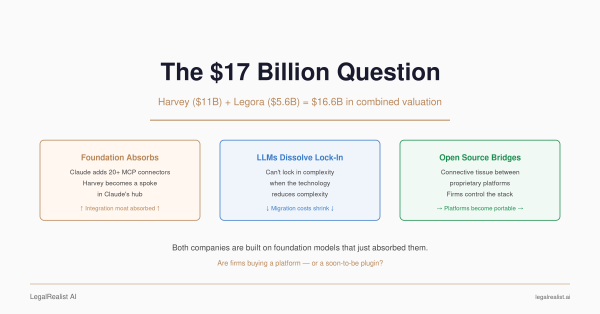
Three months later, the answer is clearer. Anthropic isn’t replacing the application layer – it’s becoming the surface those applications plug into. Thomson Reuters didn’t just survive the plugin launch; it built a bidirectional MCP connector that lets Claude call CoCounsel as a tool, and is rebuilding the next generation of CoCounsel on Claude’s Agent SDK. Harvey – valued at $11 billion after a $200 million raise in March – now has its own connector inside Claude. So does Legora, the Swedish rival that raised $600 million and hired Jude Law for an ad campaign.
Harvey CEO Winston Weinberg told Artificial Lawyer: “Gabe and I have said for years that long term we would end up competing with the model companies.” But he’s also plugging in, because the alternative – being outside the platform where lawyers are already working – is worse. Thomson Reuters CTO Joel Hron framed it differently: “This isn’t about displacing incumbents. It’s about connecting these systems more directly.”
What Actually Shipped#
The GitHub repository tells you what Claude for Legal actually is: a folder of markdown files, MCP configurations, and skill definitions – open source, inspectable, and forkable. If you read our Cowork walkthrough, you’ll recognize the architecture: plugins are cookbooks; skills are recipes. What’s new is the scale, the specialization, and the connective tissue.
12 practice-area plugins replace February’s generic contract-review plugin with role-specific toolkits: Commercial, Corporate (M&A diligence, closing checklists), Employment, Privacy, Product, Regulatory, AI Governance, IP, and Litigation, plus plugins for law students, legal clinics, and a “Legal Builder Hub” for community-built skills. Each plugin starts with a cold-start interview – Claude asks about your playbooks, escalation chains, risk calibration, and house style, then writes a practice profile (stored as a CLAUDE.md file) that every skill in that plugin reads from. Feed the interview five signed MSAs, your firm’s playbook, and your escalation matrix, and the review skills get noticeably sharper than the generic defaults.
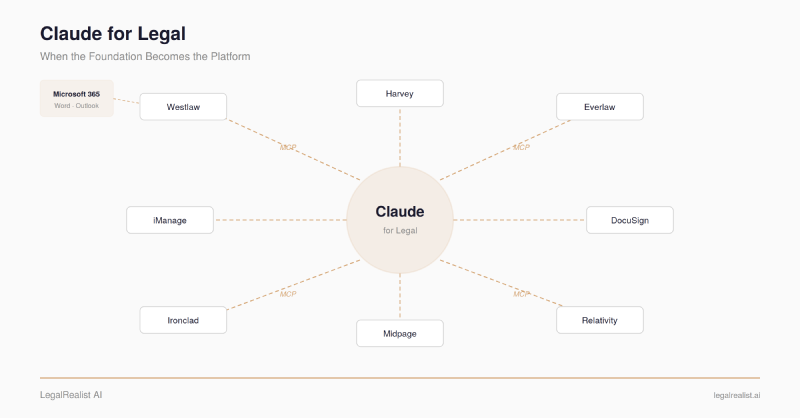
20+ MCP connectors link Claude to systems lawyers already use: Ironclad, DocuSign, and iManage for contracts and documents; Relativity and Everlaw for e-discovery; Box and Datasite for deal rooms; Midpage, Descrybe, and Trellis for legal research. Thomson Reuters provides access to Westlaw primary law and Practical Law guides. Harvey and Solve Intelligence (patent work) each have their own connectors. The full list is on GitHub.
Microsoft 365 integration embeds Claude across Word, Outlook, Excel, and PowerPoint with shared context. A redline in Word carries over to a cover note in Outlook or a board summary in PowerPoint without re-explaining the document. For lawyers who live in Word – which is most of them – this is the practical difference between a chatbot in a separate tab and a tool inside the application where work actually happens.
Access-to-justice partnerships with Free Law Project, Courtroom5, and BoardWise bring Claude to self-represented litigants and legal aid organizations. Roughly 80% of civil litigants appear in court without a lawyer. These connectors are available at no additional cost, and qualifying nonprofits get discounted pricing through a Claude for Nonprofits program.
The Inversion#
Until today, the legal tech stack looked like this: lawyers used a vendor’s product (Harvey, CoCounsel, Spellbook), and that product called a foundation model (usually Claude) underneath. The model was invisible. Lawyers didn’t know or care which LLM powered the tool, any more than they care which database engine powers Westlaw.
Claude for Legal inverts that relationship. Now Claude is the surface lawyers work in – through Cowork, through the Word sidebar, through Projects – and the vendors’ products are the connectors that plug in from below. A lawyer reviewing a vendor agreement in Claude for Word can pull Westlaw case law through the Thomson Reuters connector, check the contract against Ironclad’s clause library, and flag the output for review in iManage, all without leaving the Claude interface.
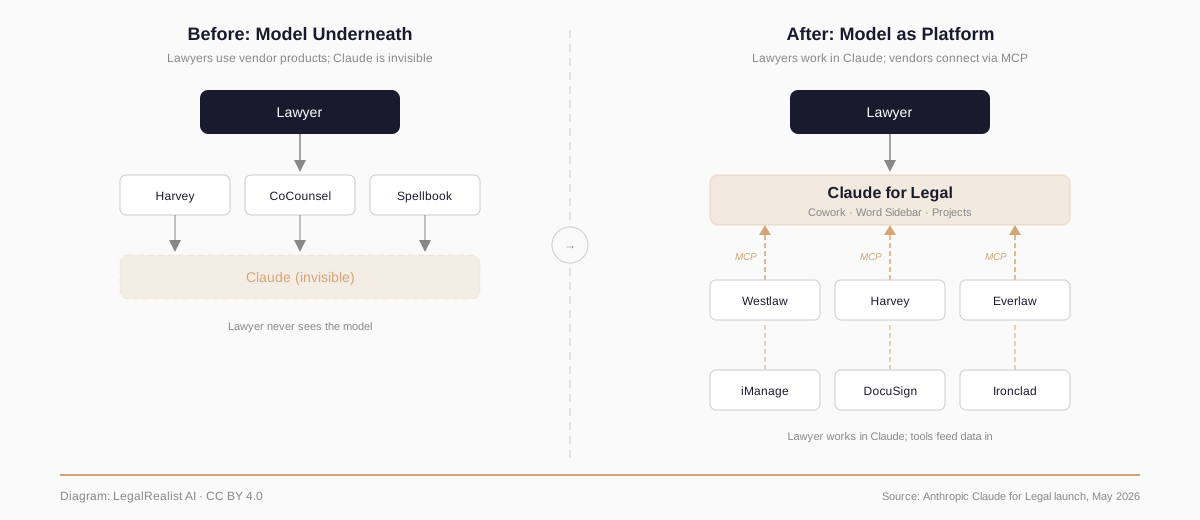
This is the same structural shift Artificial Lawyer identified: “Claude becomes the legal AI fabric, upon which the other legal tech participants embroider their additional workflows and their curated data.” The foundation model didn’t just move up the stack. It became the stack.
The playbook isn’t new. Claude already occupies this position in software development. Claude Code and the Anthropic API power a majority of the AI-assisted coding market – Cursor, Windsurf, and Augment all run on Claude, and Anthropic’s own coding tools compete directly with them. Start as the invisible model underneath developer tools, then build a surface that developers work in directly, then watch as the tools built on you become connectors that plug into you. Legal is the second professional vertical where Anthropic is running this playbook – and Anthropic’s Mark Pike told Artificial Lawyer the company sees legal as one of its “most significant and fastest-growing industries.” Financial services got the same treatment last week.
The pattern predates AI. Microsoft bundled Teams into Microsoft 365, priced it at zero, and let Slack explain to enterprise buyers why they should pay separately for something that ships free with their existing license. The European Commission eventually forced Microsoft to unbundle Teams, but by then the damage was done – Slack had sold to Salesforce at a fraction of its peak valuation. Slack was the better product by almost every measure – faster adoption, fiercer user loyalty, organic growth that enterprise software rarely sees – and it didn’t matter. Distribution and bundling beat product quality. The uncomfortable part for legal AI vendors is that Anthropic is closer to Slack than to Microsoft on product. Claude’s interface is genuinely good. If the platform player also has the better UX, the vendors can’t even fall back on the argument that the bundled version is the worse experience.
Anthropic is running a subtler version of the same play. It isn’t cloning Harvey or CoCounsel – it’s building the connective layer that makes their proprietary integration less essential. When the platform ships practice-area plugins, cold-start interviews, and MCP connectors to the same data sources the vendors use, the vendor’s remaining value proposition compresses to workflow polish, compliance tooling, and support. That’s a real moat – but it’s a services moat, not a technology moat, and services moats erode faster.
The clearest example is Thomson Reuters. CoCounsel runs on Claude. Claude can now call CoCounsel as a tool. Thomson Reuters is rebuilding CoCounsel’s next version on Claude’s Agent SDK. The company that feared being disintermediated in February is now more deeply integrated with Anthropic than it was before the panic – and simultaneously competing with it for the same lawyers’ attention. As Bob Ambrogi noted, the bidirectional integration “reflects a pattern that is becoming common: the foundation model both underlying and increasingly competing with the application layer built on top of it.”
For firms evaluating legal AI products, this creates a new question: do you start from the model and connect your tools to it, or start from the tool and let it call the model? Both paths now exist. A firm with a Harvey subscription can use Harvey’s interface and let Harvey call Claude underneath. The same firm can use Claude’s interface and let Claude call Harvey through its connector. The work product may be similar. The governance, billing, and audit trail are different.
What It Still Can’t Do#
The connectors don’t verify – they retrieve. Claude can pull a case from Westlaw, but it can’t Shepardize it. It can surface a clause from Ironclad’s library, but it can’t tell you whether that clause conflicts with the governing law in your jurisdiction. Every output still requires the same attorney judgment it would if a junior associate had drafted it – except a junior associate knows to check whether a case is still good law. Researcher Damien Charlotin’s database tracks over 1,500 court decisions globally (as of June 2026) involving AI-fabricated or AI-misrepresented legal content. Grounding reduces that risk. It doesn’t replace the lawyer as the verification layer – and Anthropic says so explicitly in the plugin repository disclaimer: “The attorney using the plugin – not the plugin, and not Anthropic – is responsible for the legal positions taken in their work product.”
For larger firms, there’s a structural gap: the platform has no concept of ethical walls. A partner working on two matters involving adverse parties sees both in the same Claude environment – no matter-level access controls, no conflict screens, no client-data segregation. The plugin architecture, where a single cold-start profile shapes every skill, wasn’t designed around the compartmentalization that conflicts rules require.
There’s also the lock-in question that the platform economics section raises in reverse. The same bundling logic that pressures Harvey and CoCounsel applies to the firms adopting Claude for Legal. Build your cold-start profiles, wire up your MCP connectors, train your associates on Claude’s interface, and you’ve created switching costs that favor Anthropic. If Claude’s pricing changes – and the subsidy cliff suggests it eventually will – firms with workflows deeply integrated into Claude’s ecosystem will face the same calculus Slack’s customers faced when Microsoft bundled Teams: migrating is technically possible but operationally expensive. The open-source plugins mitigate this somewhat – a firm can inspect the skill definitions and rebuild them on another model – but the connectors, the practice profiles, and the institutional muscle memory are harder to port. Firms should treat Claude for Legal the way they’d treat any platform bet: useful now, but worth keeping portable.
What This Means for Your Firm#
Where you sit on the AI use spectrum determines what Claude for Legal means for you.
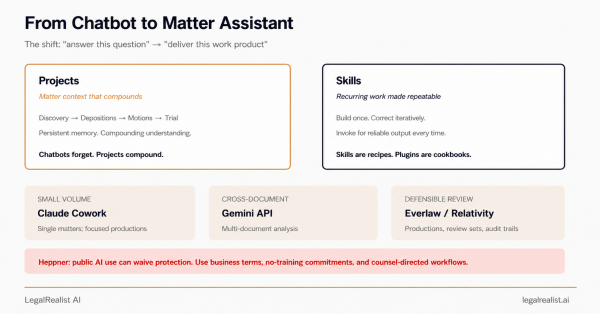
Level 1 (individual chat users): The practice-area plugins make Claude substantially more useful out of the box. A litigation associate installing the Litigation Legal plugin and running the cold-start interview will get better deposition prep and chronology-building than the generic chat interface. If you’re on a Team or Enterprise plan with no-training commitments – and after Heppner, you should be – this is the easiest upgrade path.
Level 2–3 (office harnesses and ad hoc tools): The MCP connectors are the story. If your firm already uses iManage or NetDocuments, a connector that lets Claude read from your document management system turns individual prompting into institutionally grounded work. The cold-start interview that learns your playbook is effectively a structured version of the knowledge management bridge we described in our adoption framework: connecting firm knowledge to AI workflows so outputs reflect how your practice actually works.
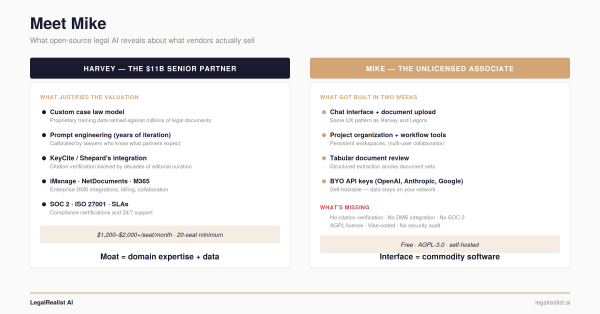
Level 4–5 (internal apps and enterprise platforms): The managed-agent cookbooks – available for Commercial, Corporate, Litigation, and Product Legal – let firms deploy Claude for Legal skills programmatically through the API. If your innovation team has been evaluating Harvey or CoCounsel, the calculus just shifted: some of what those products do is now available as open-source plugin code you can inspect, modify, and deploy on your own infrastructure. That doesn’t make Harvey or CoCounsel unnecessary – they still offer workflow integration, compliance tooling, and support that raw plugins don’t – but it compresses the gap between build and buy.
The competitive pressure matters more than any single product. For the first time, a firm can compare Claude’s open-source plugins and connectors against Harvey’s or CoCounsel’s packaged offering on equal footing – same model, same data sources, different wrapping. That doesn’t mean the vendors are overpriced; their value is in workflow polish, compliance tooling, and support. But competition compresses margins, and compressed margins benefit buyers.
The lowest-risk entry point: if you have a Westlaw subscription and a Claude Team or Enterprise plan, enable the Thomson Reuters connector. Use it for a task you’ve already completed – a contract risk memo, a deposition summary, a case law research question where you know the answer. Compare Claude’s grounded output against the same task done through CoCounsel or through manual Westlaw research. One hour of hands-on comparison will tell you more about whether the platform model works for your practice than any press release. And if your AI policy doesn’t yet account for data flowing between Claude, Westlaw, iManage, and DocuSign as a connected system – rather than between your lawyers and a single vendor – now is the time to update it.
Further Reading#
- Claude for the Legal Industry. Anthropic’s official announcement and product overview.
- Claude for Legal – GitHub Repository. Open-source plugins, skills, and MCP configurations.
- Claude For Legal Launches, May Reshape the Legal Tech World. Artificial Lawyer’s coverage including Q&A with Anthropic’s Mark Pike and comments from Harvey and Thomson Reuters.
- Anthropic Goes All-In on Legal. Bob Ambrogi’s detailed breakdown of connectors and plugins on LawNext.
- Even as Hallucinations Show Up in Legal Filings, Big Law Goes All In on AI. Fortune’s analysis of adoption despite ongoing fabrication risks.
- The AI Legal Services Industry Is Heating Up. TechCrunch’s overview of the competitive landscape.
- Sullivan & Cromwell Files Emergency Letter on AI Hallucinations. Above the Law’s coverage of the April filing incident.
- AI Hallucination Cases Database. Damien Charlotin’s running tracker of 1,500+ court decisions (as of June 2026) involving AI-fabricated content.
- Harvey Raises $200M at $11B Valuation. CNBC on the legal AI funding environment.
- Nvidia Backs AI Legal Startup Legora. Legora’s $600M Series D and Nvidia’s first legal tech investment.
This post is part of the Legal AI Arms Race series on LegalRealist AI. It is intended for informational and educational purposes only and does not constitute legal advice. AI capabilities, product features, and integrations described here reflect publicly available information as of the publication date and are subject to rapid change. Anthropic advises against using Claude for Legal for high-stakes or regulated legal work without attorney review. Laws and ethics rules governing AI use in legal practice vary by jurisdiction.